
On this page
What gets installed
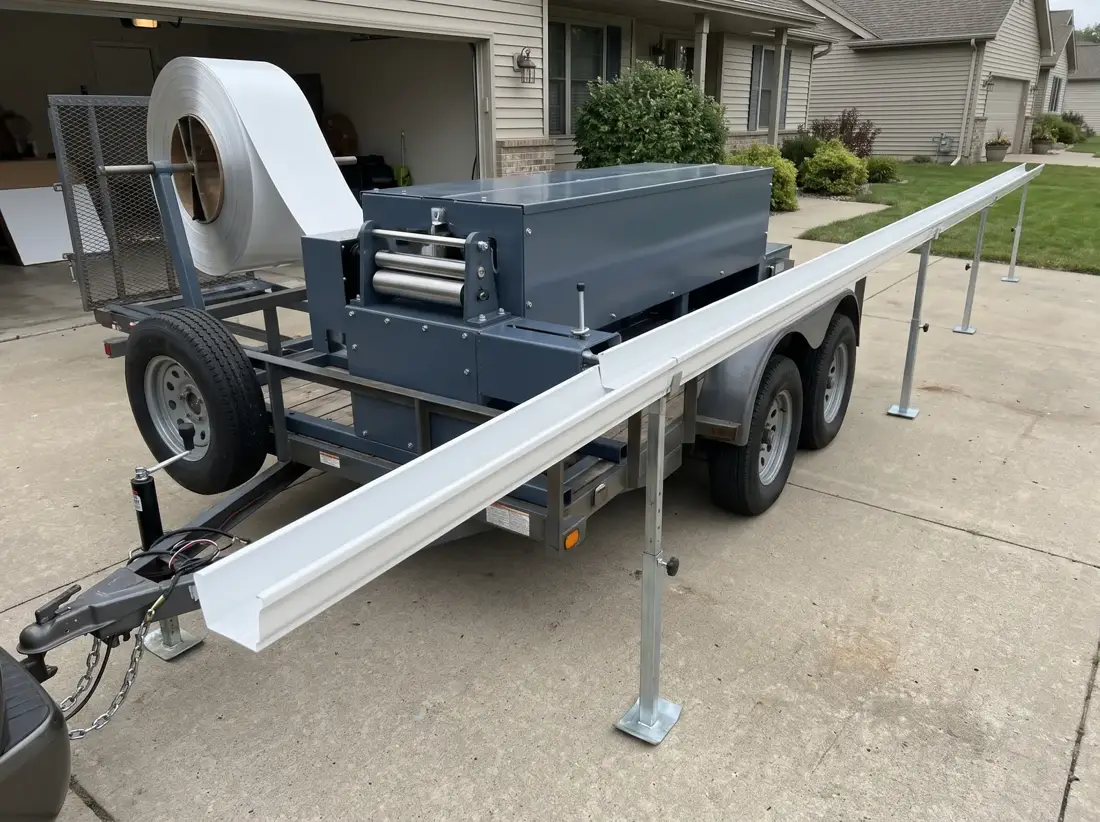
Most Indianapolis houses are fitted with seamless aluminum K-style gutter, 5 or 6 inches wide, with rectangular downspouts. The contractor brings a coil of painted aluminum and a forming machine, and makes each length to fit the wall it is going on.
| Choice | Usual answer | When to choose differently |
|---|---|---|
| Profile | K-style | Half-round on houses built before about 1940 |
| Width | 5-inch | 6-inch for large or steep roofs and long runs |
| Metal | Aluminum | Steel for strength, copper for period houses |
| Joints | Seamless | Sectional only on sheds and small outbuildings |
| Downspouts | 2x3 with 5-inch, 3x4 with 6-inch | More downspouts on long runs |
How a sound installation goes
- Measure and plan. Every roof edge is measured. The contractor decides where the high point of each run is and where each downspout will stand.
- Check the fascia. The board behind the gutter is probed for rot. Soft wood is replaced first, because it will not hold a screw.
- Form the gutter. Each length is run out of the machine and cut to the inch.
- Hang it. Hidden hangers are screwed through the back of the gutter into the fascia, no more than two feet apart. The run falls toward the outlet by about a quarter inch in ten feet.
- Seal the joints. Corners, end caps and outlets are sealed on the inside.
- Fit downspouts. Each is strapped to the wall and ends in an elbow and an extension.
- Test. Water is run through from the high end.
Built for Indianapolis conditions
Thunderstorm rain. The city receives about 42.4 inches of rain a year, most of it in thunderstorms, and May is the wettest month. A gutter has to carry the heaviest ten minutes of a storm. That is a question of width, downspout size and the number of outlets.
Snow and ice. An average season brings 25.9 inches of snow. Ice in a gutter is heavy, and it is hanger spacing that decides whether the gutter stays on the wall.
Flat ground. Indianapolis stands on a level plain of glacial till. Water does not run away from a house by itself. Where the downspouts discharge matters as much as the gutter. See the guide to downspout drainage.
Sewer rules. The local utility asks that downspouts discharge onto the ground at least three feet from the building and not into the sewer. New downspouts should be planned with that in mind.
Questions to ask before you agree
- What thickness is the aluminum? Ask for 0.027 or 0.032 inch.
- What hangers, and how far apart?
- How many downspouts, and where will each one send its water?
- Is removal of the old gutters included?
- What happens if rotten fascia is found? Ask for a price per foot.
- Is drip edge or a gutter apron included where the roof has none?
What it costs
Installation is priced by the foot. The cost guide gives published ranges and worked examples.
Rough price for your house
$1,440 to $2,240
A guide only, built from current national price ranges (Angi aluminum gutter cost guide, This Old House seamless gutter cost guide). Corners, downspouts, fascia repairs and access change the figure. Call and a local contractor will measure and quote the real one.