
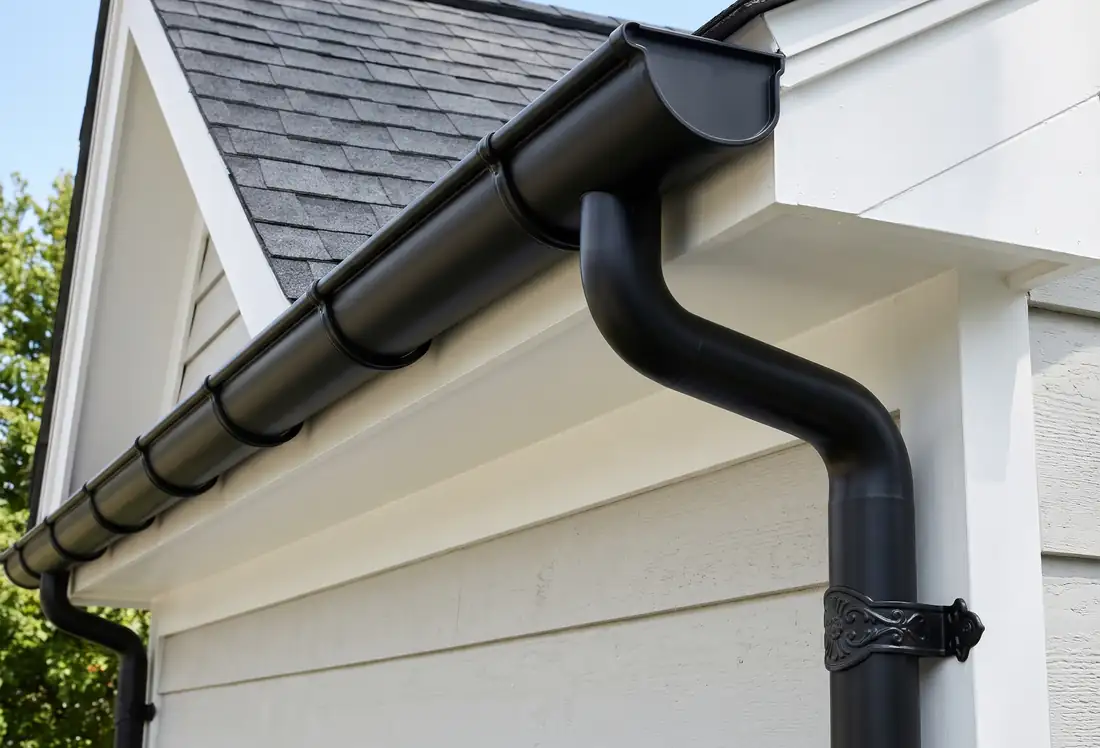
What it is
A half-round gutter is a simple half pipe carried on brackets, with round downspouts. It was the standard before K-style took over in the middle of the last century.
Where it belongs
Indianapolis has many streetcar-era neighborhoods, along with 13 local historic districts and five conservation areas. In those streets, half-round is usually what the house had when new.
- Craftsman bungalows with open eaves and exposed rafter ends
- American foursquares
- Tudor and Colonial Revival houses of the 1920s and 1930s
- Victorian houses with deep cornices
How it is hung
K-style gutter has a flat back that screws to the fascia. Half-round does not. It sits in brackets, and the bracket is chosen to suit the roof edge:
- Fascia brackets where there is a flat board
- Rafter-tail brackets on open eaves with no fascia
- Roof straps fixed to the deck under the first row of shingles
Brackets go at two feet or closer. Good ones are cast or heavy stamped metal. Light brackets bend under ice.
Trade-offs
| Half-round | K-style | |
|---|---|---|
| Capacity at the same width | Less | More |
| Self-cleaning | Better; smooth curve sheds debris | Corners hold debris |
| Cost | Higher: brackets and more labor | Lower |
| Look on older houses | Correct | Out of period |
Because it carries less, half-round is usually fitted one size up: 6-inch where a K-style gutter would be 5-inch.
In a historic district
In a locally designated historic district, exterior changes can need approval from the city's historic preservation commission. If your house is in one, check before choosing a new profile or material. A like-for-like replacement is the simplest case.
Materials
Aluminum in a painted finish is the usual choice. Copper is the traditional one on the best houses. Galvanized steel is also made in half-round.