
On this page
Find the fault first
Water pours over the front edge in heavy rain
Most often a clog at the downspout outlet, or a run that has lost its slope and holds water in the middle. On steep or large roofs it can also mean 5-inch gutters are undersized for the roof area. The fix is to clear the outlet, check the pitch with a level, and re-hang the run or go up a size if needed. See 6-inch gutters.
A steady drip at a corner or end
Sealant at a miter or end cap has dried out and cracked. Corners and end caps are the only joints in a seamless system, so this is the most common leak of all. The joint is cleaned back to bare metal and resealed. See leak repair.
The gutter sags or is pulling away from the house
Hangers have loosened or are spaced too far apart, often after a winter of ice load. If the fascia board behind is soft, new screws will not hold until the wood is replaced. See sagging gutters and fascia repair.
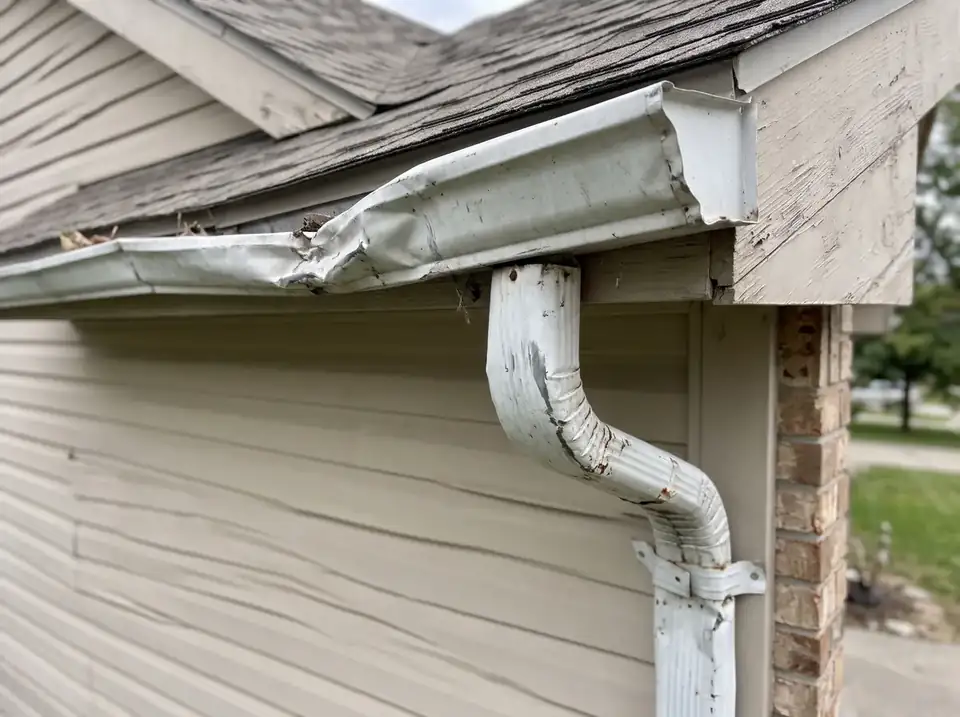
Dents and dings after a hailstorm
Small dents are usually cosmetic. Dents deep enough to hold water, split seams and crushed downspouts affect how the system drains. The hail damage guide shows what to look for from the ground. See also hail and storm repair.
Water pools by the foundation or in a window well
The downspout is discharging too close to the house, or an underground drain line is blocked. An extension or a re-routed downspout usually solves it. See downspout repair.
Thick ice and icicles along the eave in winter
That is an ice dam, and it starts in the attic, not the gutter: heat leaking through the roof melts snow, which refreezes at the cold edge. The gutter takes the weight. A contractor can repair what the ice pulled loose and tell you what they see at the eave. See ice dams and gutters.
Common repairs
| What you see | Usual cause | Repair |
|---|---|---|
| Drip at a corner or end | Sealant has dried and cracked | Reseal the joint |
| Water standing in the gutter | Run has lost its fall | Re-hang and re-slope |
| Gutter tipping forward | Spikes have worked loose | New hidden hangers |
| Water down the wall behind the gutter | No drip edge, or gutter set too low | Fit a gutter apron |
| Overflow at one place in heavy rain | Blocked outlet, or too few downspouts | Clear it, or add a downspout |
| Soft or peeling board behind the gutter | Long-term leak | Fascia repair |
| Dents, splits, crushed downspout | Hail, wind or a ladder | Replace the damaged length |
| Gutter pulled down after winter | Weight of ice | Re-hang with closer hangers |
What a proper repair looks like
Resealing. Old sealant is scraped out and the metal cleaned and dried. New gutter sealant goes on the inside of the joint. A smear of caulk over the outside lasts one season.
Re-hanging. The run is taken off its old fixings, a line is struck for the fall, and hidden hangers are screwed in at two-foot spacing. Old spike holes are sealed.
Replacing a section. With seamless gutter, a new length is formed to match. Color match is close on recent gutters and less so on ones that have faded for twenty years. A contractor should tell you that before starting.
Why gutters fail in Indianapolis
- Freeze and thaw. Winter temperatures cross freezing again and again. Metal moves each time, and sealant at the joints takes the strain.
- Thunderstorms. Wind lifts gutters that are held only by spikes. Limbs come down on them.
- Hail. The storm of April 14, 2006 led to about 282,500 insurance claims in the state, many for roofs and gutters.
- Trees. Blocked gutters hold water, and standing water finds every weak joint.
Repair or replace?
Repair when the metal is straight and the trouble is at joints or fixings. Replace when the gutter is creased, corroded or patched in many places, or when the fascia has to come off anyway. The guide to repair or replace goes through it step by step.