
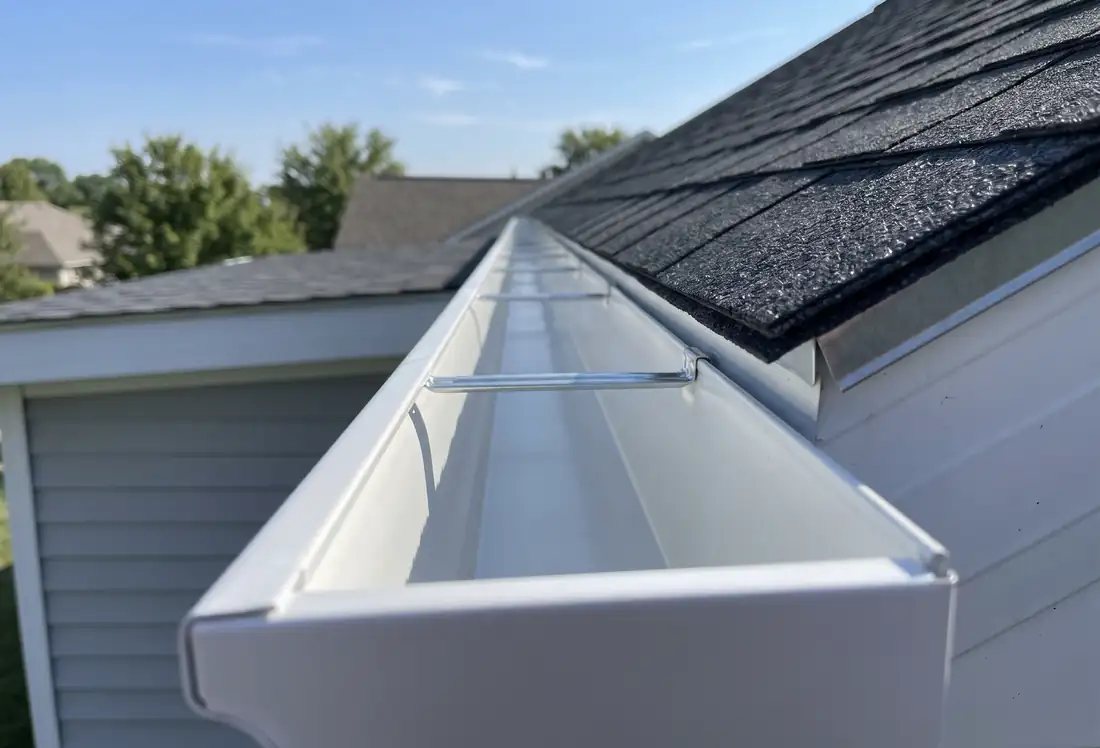
Why it is the standard
- No rust. Aluminum forms a thin oxide layer and stops there.
- Light. Easy to lift in long lengths, and little load on the fascia.
- Formable. It runs through a seamless machine.
- Pre-finished. The coil is painted at the factory and baked.
- Price. Published guides put it at about $9 to $14 a foot fitted for 5-inch.
Thickness is the detail that matters
Aluminum coil for gutters is sold in several thicknesses. The two worth having on a house are:
| Thickness | Use |
|---|---|
| 0.027 inch | Standard residential |
| 0.032 inch | Heavier; better against ladders, hail and ice |
Thinner coil exists and is used on cut-price jobs. It dents when a ladder leans on it. A quote should state the thickness.
How it stands up here
Hail. Aluminum dents. After the storm of April 14, 2006, dented gutters were part of a great many claims. A dent that does not hold water is cosmetic.
Ice. Aluminum is strong enough if it is hung closely. Failures in winter are nearly always fixings, not metal.
Heat and cold. Aluminum expands more than steel or copper. Long runs need a little room at the ends, and the sealant at corners does the flexing. That is why corners are the first place to leak.
Sun. Factory finishes last well but chalk and fade over fifteen to twenty years. Dark colors show it most.
Against steel
Galvanized or coated steel is stiffer and resists dents and ladders better. It is heavier, costs more, and rusts wherever the coating is cut or scratched. On most houses aluminum is the better balance. Steel suits places where ladders, ice or falling limbs are a regular problem.
What not to mix
Plain steel screws in aluminum gutter corrode. Fixings should be aluminum, stainless or coated. Water running off copper flashing onto aluminum will pit it.