
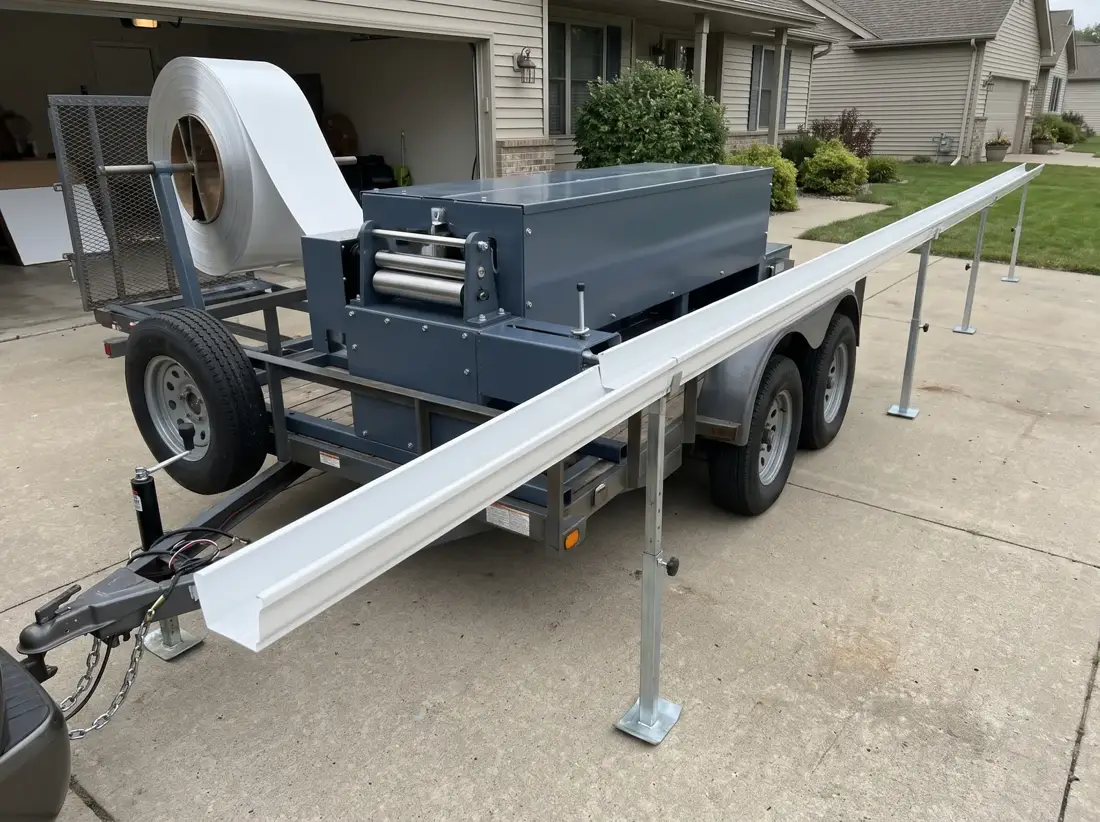
How it is made
The contractor arrives with a roll of flat painted aluminum and a roll-forming machine on a truck or trailer. The coil is fed in at one end and comes out the other as finished gutter. Each length is cut to the measured length of the wall it is for.
A 38-foot wall gets one 38-foot gutter. The only joints are at corners, end caps and downspout outlets.
Seamless against sectional
| Sectional | Seamless | |
|---|---|---|
| Joints | About every 10 feet | At corners and outlets only |
| Leaks | Each joint relies on sealant | Far fewer joints to fail |
| Fit | Stock lengths cut down | Made to the length of each run |
| Look | Visible bands along the roofline | One clean line |
| Who fits it | Homeowner or contractor | Contractor with a machine |
Why it suits this climate
Indianapolis winters cross the freezing point many times. Metal expands and shrinks with each swing, and the sealant in a joint takes the movement. Ten joints along a wall are ten places for that to fail. A seamless run has none between its corners.
Limits
- Very long walls. Lengths beyond about 40 feet are hard to carry without kinking, and long aluminum runs need room to move. A long wall may be made in two pieces that meet at a downspout.
- Tight access. If the truck cannot get close, lengths are carried in.
- It cannot be bought in a store. That is why it is a contractor's product.
What to check in a quote
- Aluminum thickness: 0.027 or 0.032 inch
- Hidden hangers with screws, at two feet or closer
- Corners mitred and sealed inside, not just capped with a pre-made piece
- Number and size of downspouts
- Removal of old gutter included
See seamless or sectional for the longer comparison.